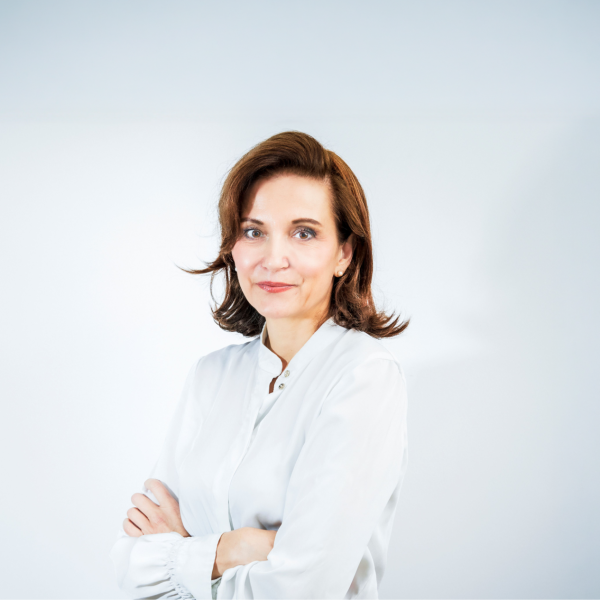





Gabriella Kindert: ‘Building Greece’s first neobank from scratch’
An interview with Gabriella Kindert, CEO of Snappi, conducted by journalist Ioanna Thoma of Fortune magazine.
Snappi’s CEO speaks with Fortune Greece & Cyprus about the challenge of “building” a neobank with a European reach from Greece, the opportunities and unknown risks of artificial intelligence, and leadership based on integrity, courage, and faith in people.
“Banks have a way of making you feel like your money is a much more complicated matter than you ever suspected. A missing document, a fee you don’t remember being told about, a process that takes more time than you have. Snappi aims to simplify bureaucracy and adapt new technologies to the modern needs of citizens.”
That was the vision of Gabriella Kindert, CEO of Greece’s first neobank. A business leader who bears no resemblance to a traditional banker. She doesn’t have her own office, doesn’t place much importance on titles, and views ego as an obstacle, not a leadership quality. During our meeting for her interview with Fortune Greece & Cyprus, she speaks with the passion of someone who knows exactly how difficult her endeavor is and, despite everything, has never considered lowering her standards. She doesn’t wait for everyone to be convinced before moving forward. She moves forward and lets the results do the rest.
Before taking over Snappi, Gabriella Kindert had already spent more than 20 years in international banking, investment management, private credit, and on supervisory boards. In Greece, however, she did not come to manage something that was already established. She came to build a bank from scratch and to put into practice a rather ambitious belief: that a country which for years had been following developments in the European financial system might one day begin to shape them.
Gabriella Kindert also talks about the trust that builds slowly, even as technology moves quickly; about the possibilities and unknown risks of artificial intelligence; and about the skepticism she has encountered along the way. She returns, however, time and again to the members of her team—those who need someone to trust them before they themselves gain the confidence to move forward. Because Gabriella Kindert wants to prove that a Greek bank can conquer Europe. But she also wants to ensure that the people who are “building” it will have grown alongside her.
You have “built” an international career in the banking sector, in investment and asset management, in private credit, and on supervisory boards, before taking on the challenge of creating a digital bank from scratch. What convinced you to make the transition from advising and overseeing organizations to “building” one of your own?
I think that life sometimes presents you with challenges, and—without knowing exactly why—your instinct pushes you to say “yes” or “no.” In this particular case, I followed my instinct. I came to Greece, had a very interesting discussion with the team members, and thought this was something truly exciting. So, I decided to accept the challenge, which turned out to be more difficult than I had imagined.
Building a bank is not just a technological endeavor; it’s a challenge involving culture, managing expectations, and coordinating various stakeholders. Above all, it’s about navigating the unknown. You don’t know what will happen, but you have to ensure that everyone is moving in the same direction.
Entrepreneurship, of course, was not new to me. At 22, I founded a venture capital firm in Hungary, and later built a hotel chain in Turkey from the ground up. When I had my second child, I handed over management of the company, as the constant travel between the Netherlands and Turkey was no longer sustainable. It was a choice I had to make as a woman and a mother, and I haven’t regretted it for a moment. I knew, therefore, what it meant to build something from the ground up. Snappi, however, brought all those experiences together in a challenge on an entirely different scale.
Having gained experience with financial institutions from both executive and supervisory roles, what views on leadership did you have to reevaluate when you yourself became the person ultimately responsible for every decision?
You need to shift your focus from carrying out tasks to aligning an entire team. For me, it’s not important to be right. What matters is that we move forward. Sometimes I’ll lose a battle; other times, I’ll carefully choose which battles are worth fighting.
When you build an organization with many different stakeholders, leadership becomes an exercise in balance and managing egos. An excellent analyst does not automatically make a good manager, just as a good manager does not automatically make a good leader. Each transition requires different skills. Many people continue to strive to be the best at what they already know, without realizing that circumstances have changed.
I strive to act as a servant leader. I want my people to grow and thrive, while I defend my team clearly and resolutely. I believe in integrity, substance, and zero ego. Ego is the enemy of leadership. Growth requires recognizing when you need to change and having the courage to do so.
Traditional banks are now investing heavily in digital services, while strong neobanks are already active in Europe. Beyond the technology, what specific value does Snappi offer its customers, and what truly sets it apart from the competition?
What sets us apart starts with a very simple principle: the bank should adapt to the customer’s life, not the customer to the bank’s processes. We don’t just want to transfer traditional banking into a pretty app. We want to eliminate unnecessary complexity and offer real value in the customer’s daily life.
Using their smartphone, customers can obtain a Greek IBAN and a digital debit card, make transfers, payments, and transactions without fees, use IRIS, and pay their bills.
At the same time, we offer savings accounts with a tiered interest rate of up to 2.25% with no lock-in period, cashback on purchases, and products such as Snappi Pay Later, which allows payment in four interest-free installments without a credit card.
With Cash Now, we offer access to small, instant loans via mobile, with a 0% interest rate and a clear, one-time administrative fee. We recently added S invest as well, so that customers can gain access to a professionally managed, personalized investment portfolio, starting with a relatively small amount. This is important to us because we don’t want to remain just an app that people use occasionally. We want to build a comprehensive banking relationship that supports them with payments, savings, financing, and—now—their investments.
I believe that we currently offer one of the best banking solutions on the Greek market, having secured full authorization from the ECB. However, products alone are not enough. True differentiation lies in the relationship you build with the customer—in transparency, simplicity, and trust. Trust isn’t earned just because someone downloaded your app. It’s built step by step, every time you prove to them that their bank is working in their best interest.
“I believe in integrity, substance, and zero ego. Ego is the enemy of leadership.”
Can a country like Greece, which is traditionally considered a peripheral player in the European financial system, establish itself as an exporter of banking innovation?
Absolutely. I have no doubt about it, and I never have. In a digital world, you can excel regardless of your background. You need to believe in yourself, dare to dream big, and surround yourself with people who believe those dreams can come true. This can happen in Greece, in Hungary, or anywhere else. I was born in Hungary under the communist regime and moved to the Netherlands when I was young. I didn’t come from a privileged background, nor did I have access to private education. Everything I’ve achieved has come from hard work and the belief that I could create something meaningful.
When I started working in venture capital, I founded a factory near the small town where I grew up. I saw the difference a business can make in the life of an entire community. Since then, I’ve deeply believed that it doesn’t matter where you were born or what happened to you, but what you choose to create out of it.
My personal mission is to instill in people the belief that they can become whatever they want to be. I’m already seeing people at Snappi thrive because we trust them, support them, and give them the tools to grow. That’s why I’m here.
Establishing a bank is fundamentally different from launching a fintech company: regulatory credibility, technological capability, and consumer trust must be in place from day one. Which of these foundations proved the most difficult to build?
None of them, and all of them at once. I had no illusions about the challenges posed by the regulatory framework. I’ve worked at a strictly regulated bank, in fintech, and as an entrepreneur, so I was well aware of the complexity of the undertaking. I also knew why similar efforts had failed in Greece.
To create a digital bank with the potential for international growth, you have to operate with a different DNA from day one. You can’t build the future with a team of people who all have the same educational backgrounds, the same experiences, and the same way of thinking. A lack of diversity will be one of the most significant reasons for the failure of companies in the future.
That’s why we’ve created a diverse team, with different nationalities, skills, and backgrounds in banking, technology, fintech, and digital transformation. Technology, regulatory compliance, and trust aren’t built in isolation. It all starts with the people and the organization’s culture.
“Snappi is highly flexible and has fast decision-making processes. This allows us to leverage AI more quickly than larger organizations.”
Many European neobanks have attracted millions of users without managing to become their primary bank. How does Snappi plan to build this deeper relationship, setting itself apart from both traditional institutions and established digital competitors?
When you start a bank, you can’t think in terms of a one-year horizon. You have to think in terms of a decade. The banking relationship is based on trust, and trust is built step by step, day by day. Our goal is to create a European neobank. When people ask me when the European expansion will begin, I reply that it began two years ago. If we hadn’t put together a management team capable of leading this expansion back then, we wouldn’t have been able to carry it out when the time came.
You can’t grow in different European markets with a purely domestic mindset. You need a diverse team with international experience and a strong commitment to results. In Greece, I believe we already have a very competitive offering: high deposit interest rates, free transactions, and cashback through a comprehensive banking app. It’s only a matter of time before the value we offer becomes more widely recognized.
At first, we faced a lot of skepticism. There were times when I’d walk out of a meeting and see people who looked like they had “I don’t believe in you” written on their foreheads. How do I deal with that? I close my eyes. I have a favorite saying: “People believe in those who believe in something, not in those who don’t.” It doesn’t matter what others think of you. What matters is what you believe about yourself. As long as your conviction remains unshaken, you must keep going. If at any point you truly stop believing in what you’re doing, then you must walk away.
Artificial intelligence promises faster decisions, greater personalization, and broader access to credit, but it raises serious issues regarding transparency, bias, and accountability. Where should a bank draw the line between algorithmic efficiency and human judgment, especially when deciding who will receive financing?
Let’s be honest. No one fully knows the answer yet. Personally, I’m very enthusiastic about artificial intelligence and the opportunities it creates. It will accelerate our growth and allow us to focus on tasks that add real value.
Snappi is highly flexible and has fast decision-making processes. This allows us to leverage AI more quickly than larger organizations. I believe that, in the long term, it will offer significant benefits to customers, as there are still many inefficiencies in the banking sector.
Why, for example, should two customers with completely different credit profiles pay the same interest rate on a consumer loan? Today, these differences are often smoothed out because we lack sufficient personalization and accurate risk profiles. Data—even more so than AI itself—is the foundation. Combining it with artificial intelligence can lead to fairer and more personalized offers.
AI, however, also poses risks that we may not even be able to imagine today. What would happen if a service like ChatGPT stopped working? How would businesses that depend on it continue to operate? What would happen if the price of tokens changed drastically? Artificial intelligence is beginning to resemble essential infrastructure, such as electricity.
We don’t have all the answers, nor do we know if we’ve anticipated every necessary safety measure. We must balance the risk of extreme, unpredictable events with the enormous opportunities. I view AI with great enthusiasm, but also with equal caution. I always try to make decisions that I won’t regret later.
Snappi must move at the pace of a technology company while maintaining the discipline and accountability of a regulated bank. What leadership principles allow you to reconcile these seemingly conflicting demands, and what aspect of the culture you are building remains non-negotiable?
Our culture is based on three elements: diversity, an open mind, and flexibility combined with passion. We need people with different experiences and ways of thinking, because no one knows for sure how the world will evolve. An open mind means that it doesn’t matter if I’m right just because I’m the CEO. People need to be able to voice their concerns, challenge a point of view, and quickly seize every opportunity.
I don’t believe in strict hierarchies, nor do I think a title should automatically confer privileges. I don’t have my own office; I sit alongside the rest of the team. I believe in meritocracy and in recognizing those who possess substance, an open mind, and the ability to add real value.
Integrity is non-negotiable. With it come the absence of ego, meritocracy, and the freedom for people to speak openly.
Looking five years ahead, what achievement would make you feel that the personal and professional risks involved in founding Snappi were worth it? On a broader level, how would you like the bank to change Europe’s perception of innovation originating in Greece?
I would truly consider myself successful if we could prove that a Greek neobank can succeed on a pan-European level. Greece has the necessary expertise. What’s needed is greater confidence in its potential and the courage to turn that knowledge into European success. Perhaps the paradox is that it took a woman from abroad to help people here believe more in themselves.
Success, however, will not be measured solely by the bank’s growth. If, along the way, I can help our team members grow, seize opportunities, and reach their full potential, then I will be truly happy.
Many of the people I’ve given a chance to ask me how they can thank me. I tell them they can’t—at least not me. The only way they can repay me is to remember, ten years from now, to give someone else a chance as well.